The Amazon Big Spring Sale was the first major retail event since Amazon overhauled its reporting infrastructure - and the timing couldn't have been more disruptive. Changes that fundamentally altered how performance data is surfaced hit just days before peak traffic, creating a visibility gap at exactly the moment optimization matters most. Here's what we learned navigating it, and what it means for what's coming next.
Now that the dust has settled and the data is final, we thought it would be a great time to share some key insights, tips to prepare for the next sales events, and our main takeaways. Here is how we navigated the new infrastructure and what we learned.
1. The Curveball: Tech Agility in a Data Blackout
As you probably know, shortly before the sale, Amazon rolled out significant updates to their reporting systems. Losing access to familiar data right before a major event was a significant hurdle for us as performance marketers. To overcome this, our R&D and eCommerce teams worked around the clock to recalibrate our internal tracking and bidding algorithms using new heuristics, models, and advanced AI tools.
However, technology was only half the battle. This "blackout" forced us to redefine our sampling and testing methodologies on the fly. We had to challenge our long-standing historical benchmarks and embrace a mindset of calculated risk-taking at a much faster pace than usual. By shortening our feedback loops and trusting our new models sooner, we were able to stabilize performance while the landscape was still shifting.
- Main Learning: Data Agility is Non-Negotiable. Rigid systems and old methodologies break under pressure. Your infrastructure and your mindset must be built for rapid recalibration so you don’t lose momentum when platforms shift.
- Actionable Item: Prepare your team to challenge legacy benchmarks and pivot testing methodologies quickly. Ensure your tech stack supports real-time adjustments to tracking systems and bidding algorithms to match new reporting infrastructures.
2. The Strategy: Precision Over "Spray and Pray"
With the reporting shift making real-time optimization more complex, our foundation of hyper-personalization became our biggest asset. We moved away from generic promotions, instead tailoring both our content selection and creative execution to the specific product or audience niche.
This dual-pronged approach was designed to move the needle on two fronts: high-impact creatives to drive CTR, paired with highly relevant product curation to boost CVR. By aligning the visual "hook" with the actual consumer intent of the season, we turned casual browsers into high-intent shoppers.
- Main Learning: Hyper-Personalization is the Ultimate Conversion Lever. Success came from matching specific verticals to the right audiences.For example - we know that Spring brings with it travel opportunities which makes travel-related products more relevant.
- Maximizing Meta MAPI: Our proprietary tech fully leverages Meta’s Marketing API to sharpen audience targeting, maximize delivery precision, and ensure the right products reach the right shoppers - backed by our long-standing partnership with Meta. [Watch our case study about this here>
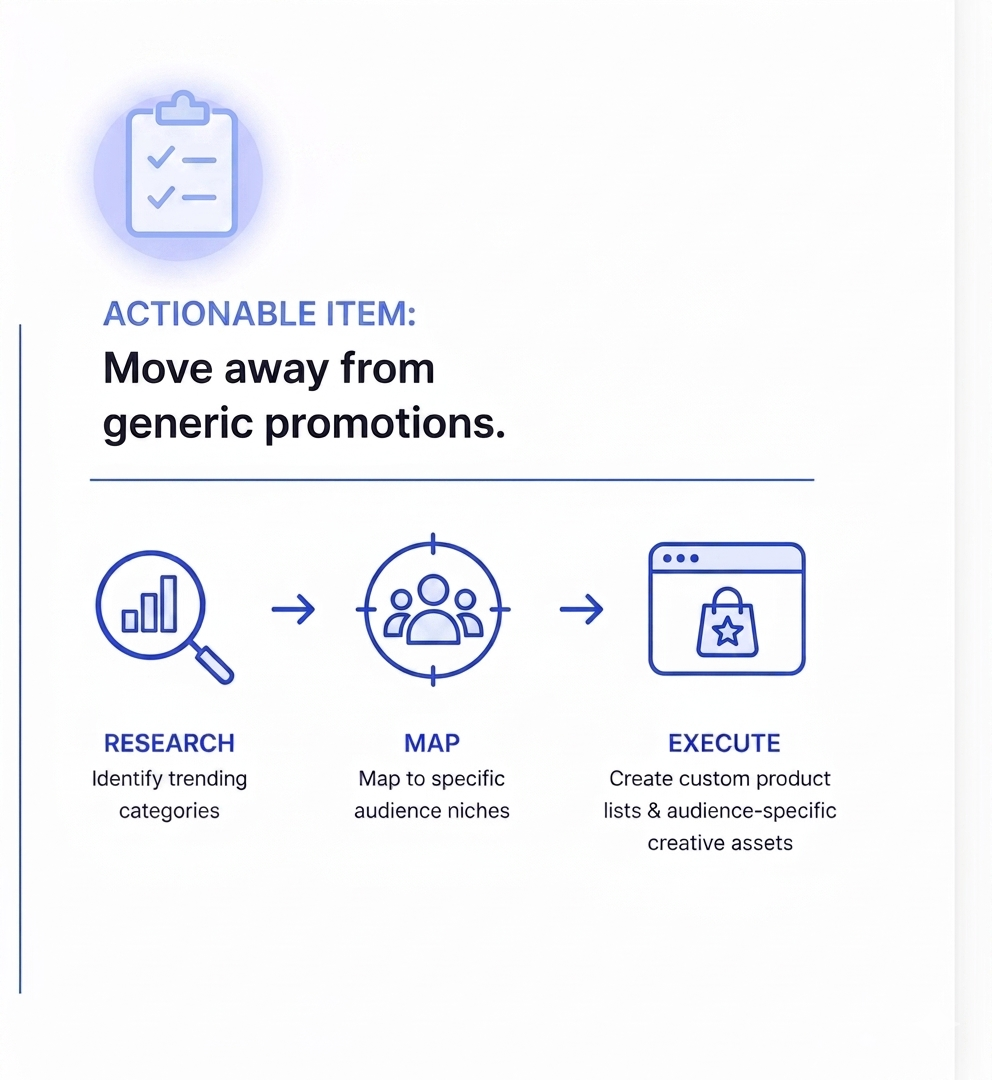
- Actionable Item: Move away from generic promotions. Invest in deep market research to identify trending categories and map them to specific audience niches through both custom-built product lists and audience-specific creative assets.
3. Scaling on Signal: Building a High-Velocity Decision Tree
In the wake of the reporting rollout, waiting for "final" attribution is a recipe for missed opportunities. Our success during this event wasn't just about the final numbers; it was about our ability to take calculated risks based on KPIs such as: CPC & CTR, and leverage top-funnel momentum.
- Main Learning: Leading Indicators are the New North Star.
When full-funnel conversion data is delayed, scaling plans need to be built around early signals. To support this, we developed a prediction model that analyzes thousands of performance scenarios and helps identify where momentum is building before the official data fully catches up. This allowed us to recognize promising categories, validate directionality, and make faster budget decisions while the event was still unfolding.
By relying on predictive modeling instead of waiting for platform-level confirmation, we were able to scale with greater confidence, reduce missed opportunities, and keep our teams focused on execution rather than uncertainty.
The Bottom Line
By being faster and more adaptable than the hurdles thrown our way, we achieved:
- +55% ROAS
- +40% Product Conversion Rate
- -10% CPC
Looking Ahead: The Next Prime Day Shift
A few structural lessons came out of this event:
- Data flexibility matters more than data completeness
Systems must operate under partial or delayed reporting without losing execution speed. - Upstream alignment reduces downstream fragility
Strong audience-to-product matching reduces dependency on real-time optimization. - Preparation determines how much disruption matters
The better the inputs going in, the less impact temporary system instability has.
One more important takeaway: scaling today is no longer just about increasing budgets. Testing multiple audiences, offers and creative directions at speed has become extremely complex, especially when teams need to connect performance data across platforms and view it in one place.
This is where having a full technological infrastructure becomes critical. It allows eCommerce and performance teams to stay focused on strategy, category selection, and optimization, instead of getting pulled into the technical complexity of data alignment. Without that kind of system in place, building true scale is almost impossible.
This is especially relevant heading into the next major retail cycle. Amazon Prime Day is expected later in June this year, earlier than its typical July timing. That shortens the preparation window and increases the importance of category focus, partner alignment, and infrastructure readiness.
Are you ready to maximize the June 2026 cycle? Feel free to reach out to the team at Kueez.

.avif)